Cary teen wins national scholarship for Alzheimer's research and awareness efforts


CARY, N.C. (WTVD) -- A Cary teenager who turned a personal family challenge into groundbreaking scientific research has earned national recognition for her efforts to advance Alzheimer's disease awareness and early detection.
Kenna Zhang, a recent graduate of Cary Academy who will attend the Massachusetts Institute of Technology this fall, was named the first-place winner in the video category of the Alzheimer's Foundation of America's 2026 Teen Alzheimer's Awareness Scholarship Contest. The award includes a $5,000 college scholarship.
The recognition comes as Alzheimer's disease continues to affect millions of Americans and families nationwide.
"For my grandmother, the signs were there, but we didn't recognize them in time," Zhang said.
Her journey began years ago after her grandmother was diagnosed with Alzheimer's disease.
"My grandmother was diagnosed with stage three Alzheimer's by the time she had gone to the doctor," Zhang said. "At that time, it was too late. So, it kind of made me think about what I can do to make Alzheimer's detection early on and more accessible for people."
According to Zhang, her family initially overlooked early warning signs, attributing changes in her grandmother's behavior to normal aging. The experience inspired her to become involved in Alzheimer's advocacy and research while still in high school.
What started as a personal mission evolved into a series of independent scientific research projects focused on improving Alzheimer's diagnosis.
During high school, Zhang completed three research projects examining how artificial intelligence can help detect Alzheimer's disease earlier and more accurately.
One project studied potential biases in artificial intelligence systems when evaluating patients with certain biological or genetic characteristics. Another explored ways to train AI models to assist rural health clinics that may have limited patient data available for diagnosis.
Her third project focused on combining multiple forms of medical information into a single machine-learning model.
"I created a method where you can combine tabular data and image data, and that will be fed into the machine learning model," Zhang said. "It then makes its diagnosis based off both of these data types in the initial round."
Her work gained attention beyond the classroom.
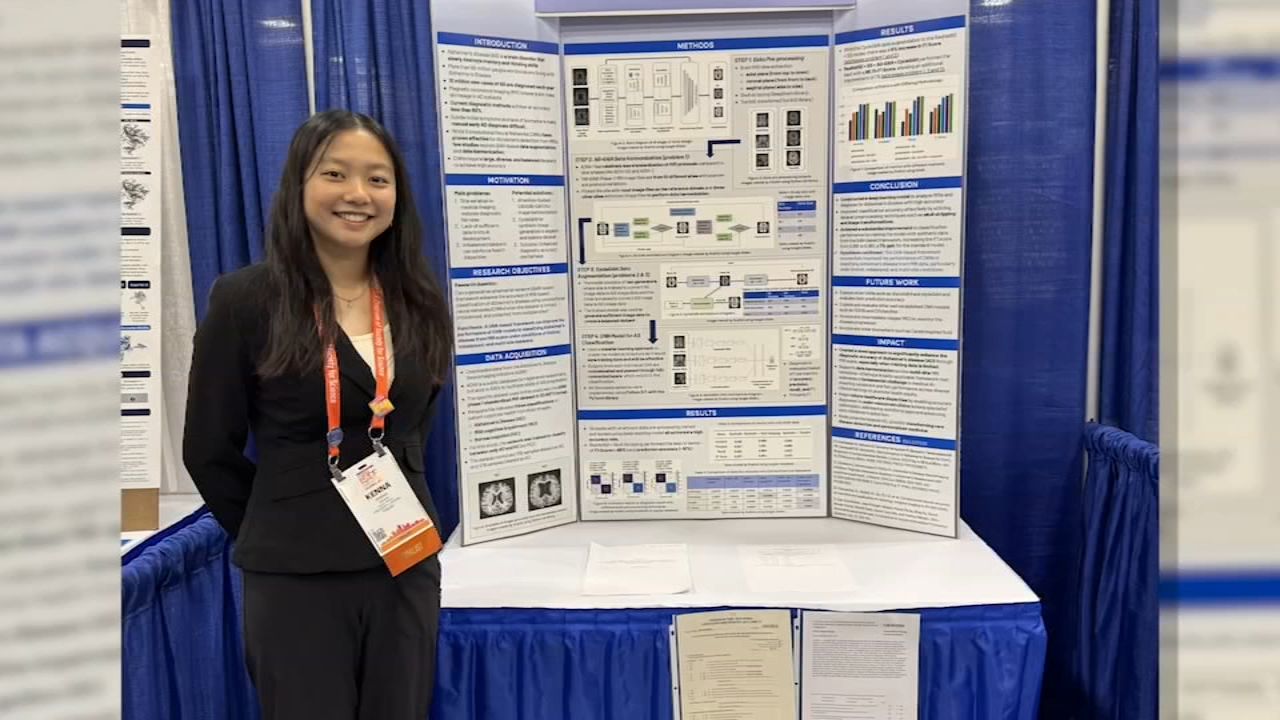
Zhang presented her research at the International Science and Engineering Fair, where she connected with researchers and industry professionals working in similar fields.
"I had the privilege to attend the International Science and Engineering Fair with my project from last year," Zhang said. "It was really cool because I got to meet a lot of industry professionals and talk to people who got to extend their research beyond the high school scope."
The experience helped shape her future ambitions.
"That was really inspirational for me because I got to see, 'Whoa, this could be something I could do in the future,'" she said.
The Alzheimer's Foundation of America praised Zhang's commitment to both awareness and scientific innovation.
"Kenna is a young leader in the fight against Alzheimer's and an inspiration to everyone whose lives have been touched by this disease," said Charles J. Fuschillo Jr., the foundation's president and chief executive officer. "She's sharing her story to help raise awareness and is actively involved in research to help find the scientific breakthrough that can't come soon enough."
The foundation's annual scholarship contest invites high school seniors to describe how Alzheimer's disease has impacted their lives and how they plan to raise awareness in the future. More than 1,400 students participated in the 2026 competition, with more than $73,000 awarded to 96 students nationwide.
For Zhang, the scholarship represents far more than financial support for college.
"I was definitely super excited," she said. "I was actually pretty shocked because I didn't realize that the stuff that I did throughout high school would have such an impact."
She said the recognition reinforced her belief that her work can make a difference.
"It gave me more power and ground to realize that the stuff that I do actually matters," Zhang said.
As she prepares to begin her studies at MIT, Zhang plans to continue researching ways to improve early Alzheimer's diagnosis and expand access to screening tools, particularly in underserved communities.
"If I keep doing it, I'll be able to make more impact in the neurodegenerative disease diagnosis community," she said. "That was just super fulfilling for me."
Driven by the memory of her grandmother and a desire to help other families avoid similar experiences, Zhang hopes her research will contribute to earlier diagnoses and better outcomes for future generations.
In her scholarship-winning video, Zhang summed up that mission simply: "In honoring my grandmother's memory, I am working to protect the memories of others."