Golden Knights-Hurricanes Game 2 takeaways, grades, questions

Down is up. Right is left. The future is the past. Nothing makes sense.
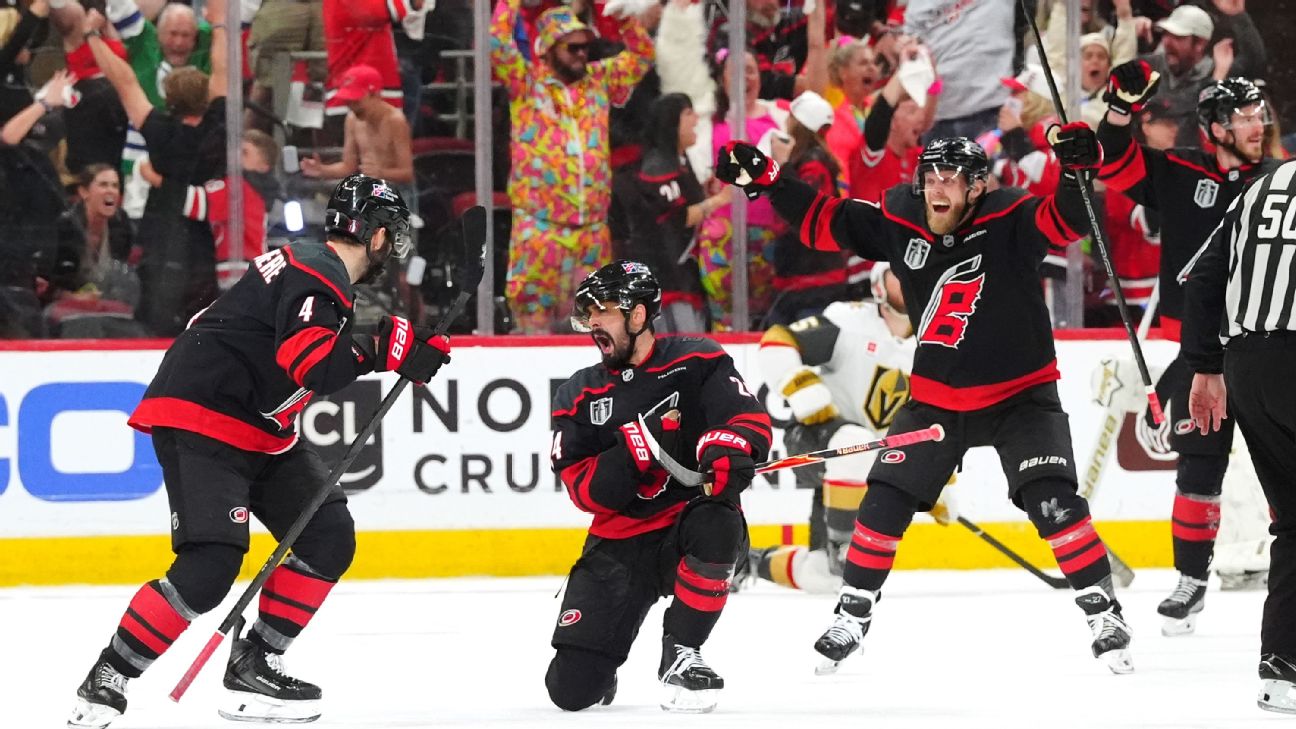
In Game 2 of the Stanley Cup Final, the hostCarolina Hurricanes trailed by two goals, scored three straight to take a lead in the third, lost that lead only to win4-3 in overtime against the Vegas Golden Knights.
Both of the first two games really came alive once the regulation clock was within the last five minutes. Now the setting shifts to Las Vegas for Games 3 and 4, with the Cup Final resuming Saturday.
Every game comes with its own set of questions and thoughts to ponder. This one had a lot of them. Here's a look at how both teams influenced the momentum of the game, the players to watch going forward, along with the looming questions heading into Game 3.


Carolina Hurricanes
Grade: B
Perhaps the easiest way to dissect this game is to look at how the Hurricanes performed in the first 50 minutes versus what happened afterward. The first 50 minutes was an extremely complicated scenario. The Hurricanes found what could be deemed success in preventing the Knights from consistently generating shots and scoring chances; the blemishes were the two goals by Brett Howden.
What overshadowed that defensive effort was how the Hurricanes had a first-period shot share of 82.1%. The top-six forward group featuring Sebastian Aho, Jackson Blake, Nikolaj Ehlers, Taylor Hall, Logan Stankoven and Andrei Svechnikov each had a shot share that was greater than 60% -- only to come away with nothing. It also didn't help that Alexander Nikishin was the only member of the Canes blue line who recorded a shot on goal by midway through the third period, an odd occurrence for a team that had four defensemen finish with more than 30 points in the regular season.
Then came the time after the initial 50 minutes. The Hurricanes broke out for three unanswered goals in the span of five minutes. One of them was from Stankoven, who won a puck battle to get his team on the board, before Mark Jankowski tied it a little more than two minutes later. GoaltenderFrederik Andersen's efforts were important throughout, but the stability he provided became even more crucial when he made the sprawling save on Ivan Barbashev that led to Vegas coach John Tortorella using a challenge because he believed the puck went in before the play was whistled dead. His challenge failed, the Hurricanes went on the power play for the delay of game, and Jordan Staal scored with less than five minutes left for a 3-2 lead.
With the momentum and the crowd back on the Canes' side, Blake was assessed a minor penalty for interference. The Canes killed it off, but the Golden Knights tied it on a 6-on-5 just eight seconds after the Hurricanes returned to full strength.
The final turning point of the game was the result of Tomas Hertlbeing called for tripping. That led toSeth Jarvis, who has been part of that much-maligned top line that hadn't scored coming into this series, scoring the winning goal in overtime.

Vegas Golden Knights
Grade: B-
Similar to the Hurricanes, the Golden Knights' performance in Game 2 can be viewed through two prisms.
The first being how they needed their defensive structure to overcome an offensive system that greatly struggled. It started with having those two-way centers such as Jack Eichel and William Karlssonwho can be paired with two-way wingers such asMitch Marner and Mark Stone, which allows their forwards to remain steadfast in their defensive approach -- especially during extended time when they don't have the puck.
Brayden McNabb's injury forced Tortorella to make lineup adjustments. Rasmus Andersson and Noah Hanifin gave the Golden Knights a consistent defense pairing, andShea Theodore played 28:30 and Jeremy Lauzon finished at 21:08. The Knights had 25 blocked shots and forced one giveaway in a game in which they struggled for goals and scoring chances aside from Howden's efforts.
That leads to the second prism being Tortorella's challenge on the potential Barbashev goal -- and the ensuing power play for the Canes. Carolina had failed to score on its first four power-play chances this series before Staal's goal that gave the Canes a late lead in the third. For a time, it appeared that Tortorella's decision to challenge was going to doom the Golden Knights.
Stone's net-front goal tied the score to force overtime, but any chance of taking a 2-0 series lead was erased after Hertl's penalty and Jarvis' winner.
Players to watch in Game 3

Andrei Svechnikov
LW, Hurricanes
This is going to be a talking point until it's not. And the "this" in this case is how the Canes are struggling to receive offensive contributions from certain members of their top six.
Svechnikov is one of the players who has faced the most scrutiny. The 6-foot-3 winger had the strongest regular season of his career, with 31 goals and 70 points. He was part of an offensive phalanx that saw the Hurricanes enter the playoffs with seven players who had 20 or more goals, and 13 who reached double figures.
Forget the fact that Svechnikov hasn't scored a goal in the Cup Final. He had only one shot in Game 1, and came into the third period without a single shot in Game 2. Svechnikov finished with no shots and one assist.

Brayden McNabb
D, Golden Knights
Is he going to be available for Game 3, or will Tortorella need to make an adjustment with his defense pairings?
As he has done all postseason, McNabb blocked a shot, but this time it was with his face and it led to him leaving the game bloodied. ESPN's Emily Kaplan reported McNabb was seen leaving the building and was taken to a local hospital.
Losing McNabb for the rest of the game meant the Golden Knights were without one of their top-pairing defensemen who had been so crucial. In the event he can't play Saturday, the Golden Knights could turn to seventh defenseman Ben Hutton, who has already played seven times this postseason, or Kaedan Korczak, who has played in 12 games in this playoff run.
Big questions for Game 3
Will the supporting cast make the difference going forward?
In Game 1, Staal's goal tied the score at 3-3 before Shayne Gostisbehere got the salvo that tied it at 4-4. In Game 2. Stankoven scored the goal that cut the lead in half, and Jankowski, a bottom-line forward, scored the tying goal before Staal scored what was a temporary go-ahead goal.
That's four goals -- Gostisbehere and Jankowski, along with two from Staal -- of the eight that Carolina has scored in the Final that have come from beyond their top-six forward group. One of the details that made the Hurricanes different compared to previous season was how they could get goals from different sources.
Could that continue in Game 3 and beyond? If so, will it be one of the factors that gets them the elusive Stanley Cup they've been seeking since 2006?
Can they get a quicker start in the offensive zone?
Finishing the first period with a 50% shooting percentage sounds great until you realize it was on onlytwo shots.
In the Rod Brind'Amour coaching era, the Hurricanes have been one of the best teams in the NHL at suppressing offensive opportunities for opponents. But the Golden Knights came into the Cup Final averaging the second-most goals per game and showed in Game 1 they could score when they dropped five to take a 1-0 series lead.
But even in that high-scoring effort, the Golden Knights had only four shots in the first period before scoring four times on 19 shots. Having Howden score twice while others were trying to find some sort of consistency was crucial. But giving up those three goals in row late in the third period of Game 2 meant they had to suddenly find counters to problems they struggled to answer all night.
Stone scored another clutch goal to send the game to OT, but questions remain as to what Knights will do to get off to a faster start, knowing that another frantic finish could await in Game 3.
]