As Raleigh's housing gap grows, advocates focus on affordability


RALEIGH, N.C. (WTVD) -- As housing costs remain high across the Triangle, affordable housing advocates, builders and real estate leaders are searching for ways to expand options for residents increasingly priced out of the market.
"There are so many people that we think are served by the Habitat (for Humanity) program. Teachers qualify for our program, policemen qualify for our program, firemen qualify for it," said Patricia Burch, CEO of Habitat for Humanity Greater Raleigh.
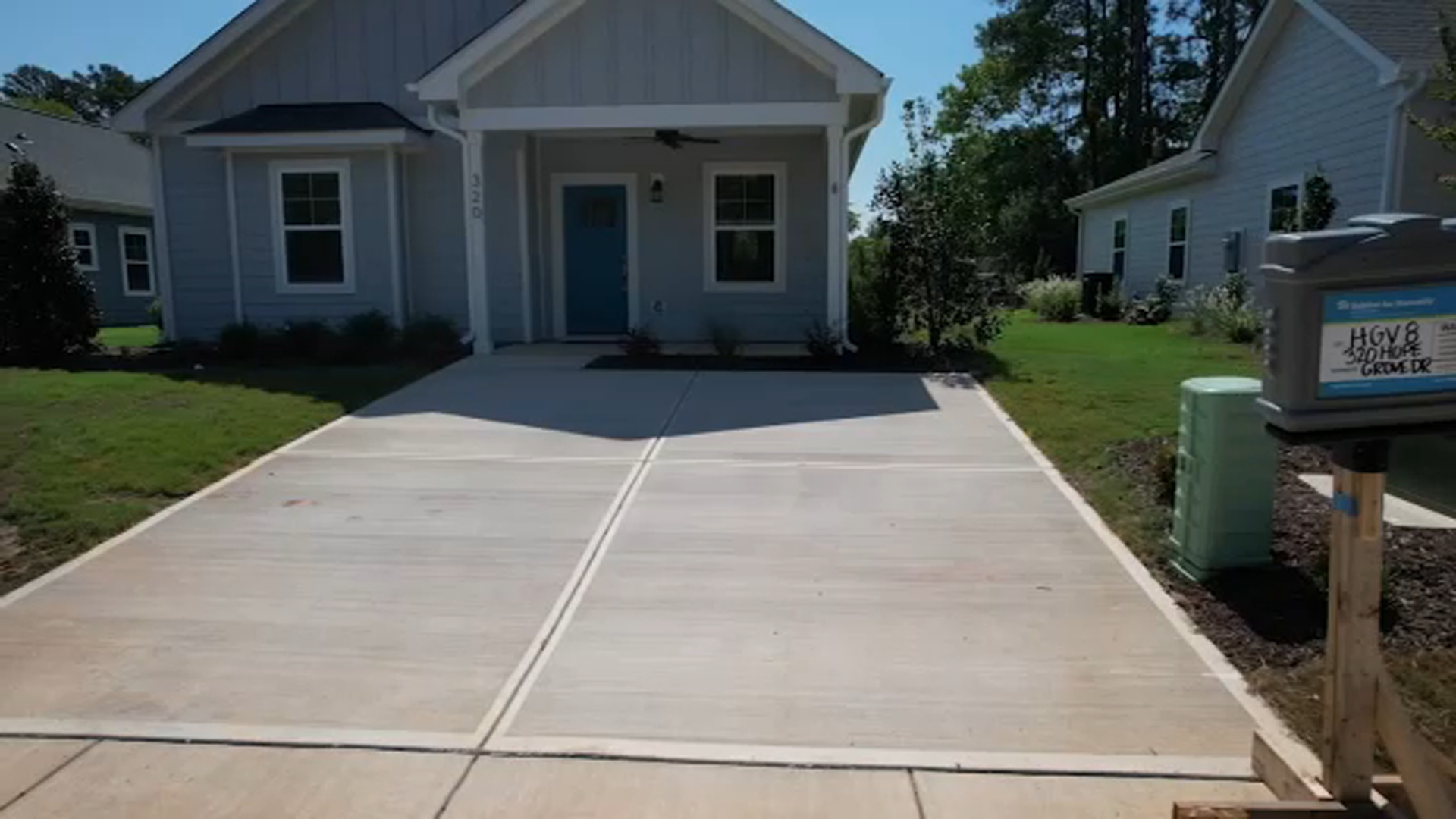
On Tuesday, ABC 11 met with Burch at Hope Grove neighborhood, a development underway in Garner that will have more than 400 homes.
Historically, Habitat's programs have focused on households earning up to 80% of the area median income.
"What we find is that that next group, that 81% to 120% area median income, is a group that's typically left out of the housing market," Burch said. "And so out here in this neighborhood, we are incorporating that group as well."
Past the pricing of a home, Burch says buildouts keep other recurring costs in mind.
"All of our houses are energy efficient," she said. "Because we are looking at not only the cost to get in a house, but the cost to stay in the house."
She said Habitat for Humanity Greater Raleigh builds out 40-48 homes a year, a pace which has picked up markedly in the past decade. On top of building new properties, they also focus on maintaining existing structures.
"Our home preservation program is a very important strategy in what we do. It is often we are finding that naturally occurring affordable housing, as it becomes older housing stock and those becoming in disrepair. A lot of times, families who have always been homeowners are not liable to stay in their house," Burch said. "What we do is come in and help them take care of those houses so that they're able to maintain it. It keeps it from being bought up, torn down, and putting larger housing on top."
The effort comes as homeownership remains out of reach for many would-be buyers.
According to Zillow, the average value of a home in Raleigh is $435,237, down 2% in the past year, though still well above what many families are able to afford.
"We'd love to see more inventory between the $250,000-$350,000 (range), just so that we have a little bit more balance than what we're seeing right now, so that people can have a first-time home," said Danielle Plourd, government affairs director for the Raleigh Regional Association of Realtors.
The association recently launched Raleigh Rising, an educational initiative intended to improve public conversations about affordable housing and what planners often refer to as "missing middle" housing.
"We can imagine different communities that do housing a little bit differently," said Sam Gunter, Executive Director of the North Carolina Housing Coalition. "And I think that is where we're not just it's not just about supply and quantity. It's about diversity of type."
A report from NC Chamber projects the state will face a housing supply gap of nearly 765,000 properties, broken up between rental and for-sale inventory, between 2024 and 2029.
"The average age of first-time homebuyer is higher than it has ever been," he said. "We have the lowest number of homebuyers right now than at any point since we've been tracking this data."



At the same time, Raleigh's national reputation continues to attract new residents.
"It's great that Raleigh is in the news," Plourd said. "We are constantly ranked No. 1 best place to live, No. 1 place for retirement. But that's attracting more and more people here."
Advocates and housing leaders agree that addressing affordability will require a mix of approaches. Proposed solutions include streamlining permitting processes and changing land-use policies.
"I think both City of Raleigh and other communities in the Triangle as well have been looking at their land use policies and trying to figure out if the legal structures they put in place that set the table for the kind of housing we have makes sense for the amount of people who are here already and are on their way. I think that's another piece, and not just in terms of density and how many homes, but in the different types of homes," Gunter said.
Gunter said the consequences of inadequate housing extend beyond individual families.
"It breaks communities in ways," Gunter said, "because if you don't have the housing in a community to support the folks in that community, it's not a community where everyone can thrive."
That means shortening the time people spend getting to work.
"We want to make sure that we have the best talent, and doing so means that they live where they work," Plourd said. "They aren't traveling an hour to home or to work, and that you get to see them interacting in regular day-to-day life as well."